
Every organization, isolated
Each organization’s context remains isolated.
An operational map for companies that grow and change
Atlas brings into one map who answers for what, how each process is done, and where the knowledge lives. Your team knows what to do without asking, newcomers have a route from day one, and you see in advance what stops if someone is missing.
Who does what · How it gets done · What happens if someone is missing
Pick a company size and we email you an access code. The workspace builds itself, with fictional data, and lasts seven days.
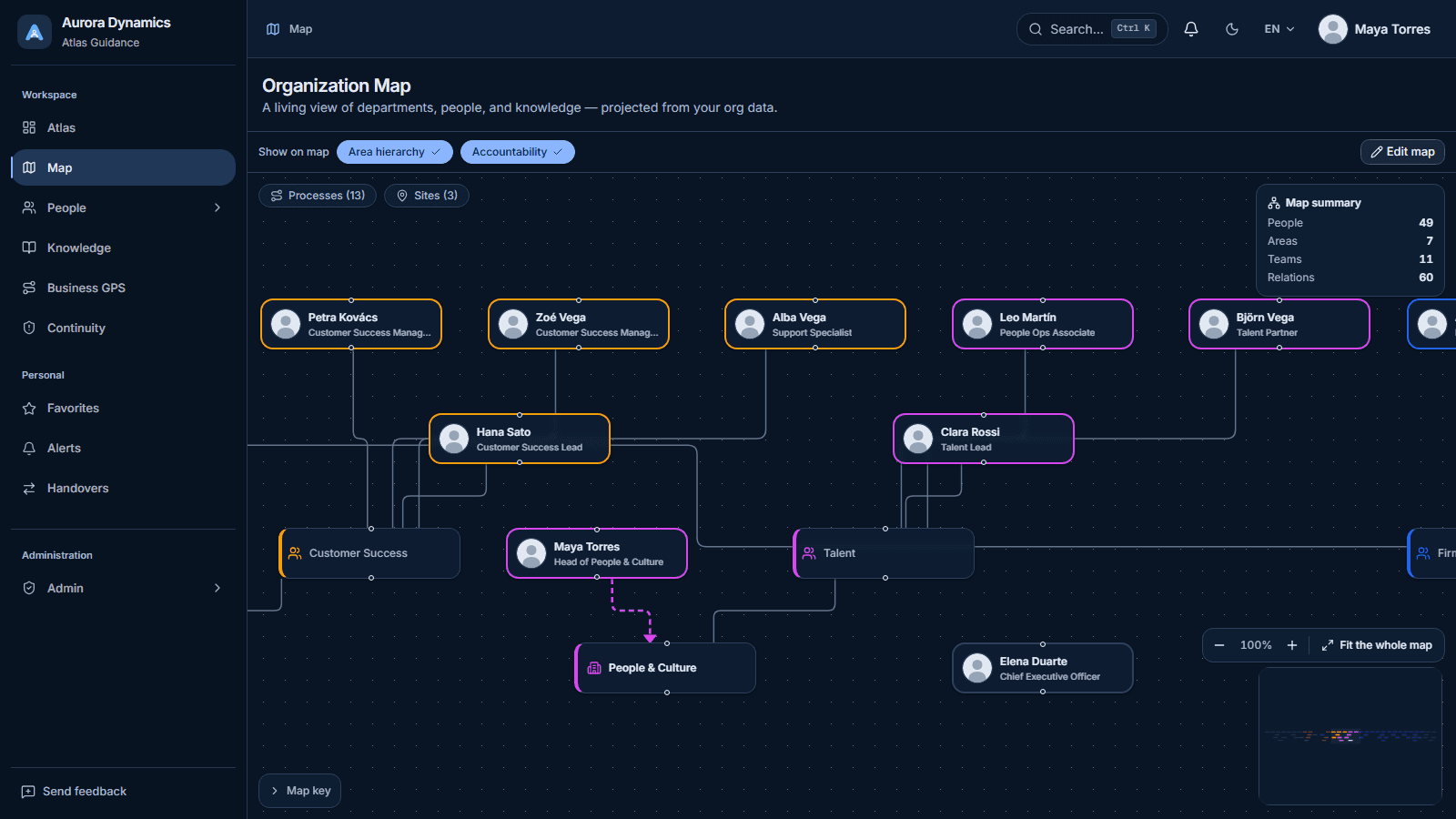
Areas, people, and knowledge, projected from your company’s data.
Nobody wrote it down, because there was always someone to ask. The cost shows up at three moments:
With Atlas, you ask whoever knows to write it down →The task only they knew how to do comes to the surface.
Atlas suggests who covers and hands them a guide with what they need.They spend weeks asking who handles what, interrupting half the team.
Business GPS shows them every step, who answers, and which document to use.They leave with processes, contacts, and documents nobody else maintained.
You see in advance what depended on that person and prepare the handover in time.Atlas knows what being covered means: for every step, whether someone available today has already shown they can do it, received it in a handover, or was named a backup and says they are ready. From that it gives you two verdicts — can the work get done, and is what’s written kept up — and tells you what to resolve first.
What Atlas reads
where it breaks, and what to fix today
And when it doesn’t know, it says so: “in charge, unconfirmed”. It never invents certainty. Every Monday, a summary per area — only if something moved.
Can the work go on if someone is missing? Start with the overall picture and open the section you need.
0 uncovered98 in charge, unconfirmed2223 covered4 don’t depend on people
ActWhat needs a decision.
Pending decisions Steps nobody can do today and critical knowledge with no owner.Nothing pending · Up to dateKey people Who is the only person able to do a step.10 people · To reviewTodayHow things stand now.
Absences and cover Who is out today, who covers them, and whether their work can be done.1 absent today · Needs attentionPositions Functions that continue even when people change.1 vacancy · To reviewAnticipateBefore it happens.
What if…? Remove people, positions or areas and see what would be left uncovered. Nothing changes.Handovers Prepare the handover of knowledge and processes before someone leaves.Leo Martín says he is ready: the step now has two capable people.
0 uncovered98 in charge, unconfirmed2223 covered4 don’t depend on people
Every process step has an owner and the knowledge to carry it out. Every role knows what it answers for. Because it is all connected, Atlas answers questions that a wiki, an org chart, or a process tool cannot answer on their own.
This is what you cannot get by bolting three tools together: none of them knows what the other two know.
Pick a process and Atlas guides you step by step: who answers, which document to use, and which way to go at each decision. Responsibility lives in the position, not the person: if someone leaves, the step passes to whoever takes their place, and if the position is vacant, the step says so.
Where do you need to go? Pick a process and follow the route.
Design a processCustomer Success1 process
Finance & Legal2 processes
Infrastructure & Platform2 processes
How a request reaches Renewals and what it leaves with.
Follow the connections and their conditions. Branches can represent alternatives, parallel work or rework.
Where do you need to go? Pick a process and follow the route.
Find a process…Ask whoever knows to document it: a draft is already waiting for them, and you are told when it is published. Atlas also points out the steps nobody has written down, starting with the ones a single person holds. Every article has an owner, a review, and the steps where it is used.
Renewals Lead · Customer Success
Responsible for ⟲ 3 steps · 1 article2 steps depend on this person aloneAsk them to write something downRequest sentScoped with the requesterThis person only
Inside the agreement?This person only
Delivered and handed on
Renewals Working Agreement
How we decide whether a renewal is inside the agreementPublished
It’s written down Ravi Iyer published “How we decide whether a renewal is inside the agreement”.
Nothing pending for now.
If your whole team fits in one room, you don’t need us. Atlas pays off once there are several areas or sites, frequent hires, and turnover that hurts.
Across the product, not on one sample screen.
You build a process and navigate the map with one finger, not just read.
Complete, and emails go out in each recipient's language.
The security basics, handled from the start.
Each organization’s context remains isolated.
Permissions are checked on the server, and each manager sees only their area.
Whoever covers an absence reads only what the work needs, and only while it lasts. Everything is audited.
Operational navigation does not depend on AI to work.
Choose how many people your company has and Atlas builds a complete demo workspace: map, processes, knowledge, and its continuity diagnosis already calculated. Go in and find the person everything depends on.
Atlas suggests whoever can do the most steps, and tells you why.
Cover confirmed: Felipe Romero covers Hana Sato from Oct 6 to 17.
You are not covering anyone today.
Management seats are what gets counted: whoever administers, approves and publishes, and the managers who follow their area’s continuity. A 300-person company does not need 300 seats.